What if your senior advisor never left the room?
Project
Liam for CGS Advisors
Year
April 2026
Award
Winner — Consulting Track, 2026 Ivey MSc Hackathon
The Client
CGS Advisors is a consulting firm based out of Indianapolis. For the last fifteen years, they've helped mid-market and enterprise clients reshape how their businesses run with a focus on digital transformation. Along the way, written some of the frameworks the rest of the consulting industry now quietly references. Maturity models. Intelligence architecture. White papers.
Their goal: stay ahead of an industry being disrupted by the same technology they help others adopt.

The consulting business is being squeezed from both sides. AI made hours irrelevant and generic expertise cheap. The work consulting firms used to charge for now sit one prompt away from any client with a Claude or ChatGPT subscription.
The brief was one line: Build the future of CGS and consulting with AI. Open scope.
We had to figure out what "the future" actually meant.
Scope of Work
CGS productized the framework. We productized the advisor.
That was the pitch in one line.
CGS already owns what makes them valuable: 15 years of frameworks, engagements, and one terabyte of accumulated thinking. The problem isn't the IP. It's delivery because CGS's intelligence only reaches the client when a partner is in the room. The client sends an urgent email and gets back "out of office until Tuesday."
So we built Liam, an always-on advisor that lives inside the client's Google Workspace because CGS is a Google shop and we assumed that their client work lives there too.
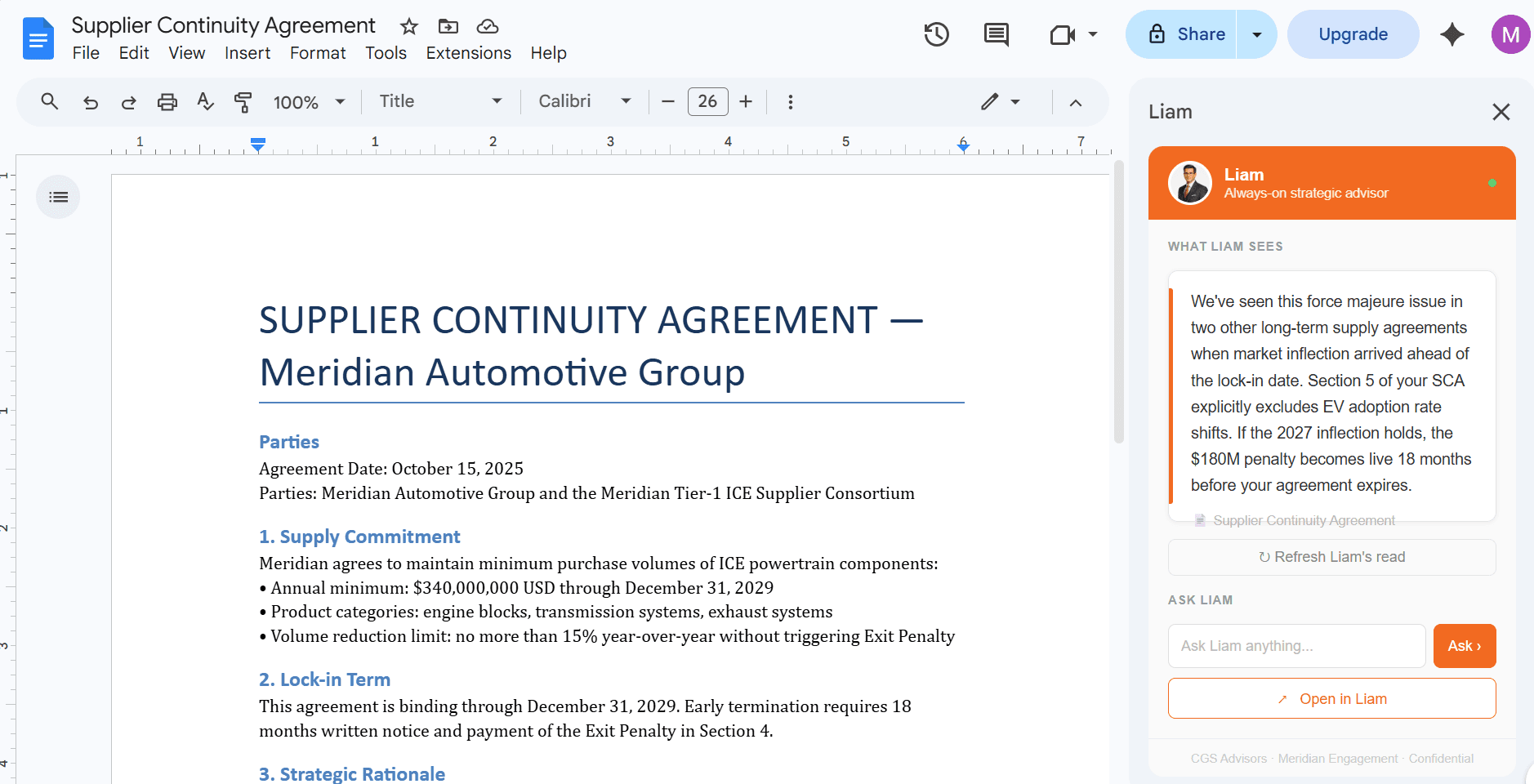
He doesn't sit in a separate platform you have to remember to open. He's ambient. In the Drive when something new lands. In the sidebar of a Google Doc the moment a contract is opened. He has a chat surface and a persona because consultants don't talk to a search bar. they talk to a person. Liam needed to feel like one to be useful as one.
Liam is an Always-on Advisor, not a copilot.
Liam reads CGS research the moment it's published and uses the new knowledge against client material to highlight/flag work that needs attention. He drafts board briefs before anyone asks. He flags clauses in signed agreements against new market signals. None of it is prompted. He works in the background and surfaces only what actually matters.
The line between a copilot and an advisor: a copilot gives you output such as drafting a doc, formatting a deck, summarizing a meeting. Liam gives you counsel. And, he doesn't just respond. He decides whether responding is the right move at all.
That distinction showed up the clearest when we asked Liam "should we walk away from a $180M supplier agreement?" for a mock client's we created.

Five agents. Three foundation models. One Workspace.

Behind the chat interface, 5 specialized agents work together. An Observer that watches the Drive for new files. An Orchestrator that classifies what kind of request came in. An Analyst that does grounded reasoning against the corpus. A Liaison that delivers in the right format. And a Governor that decides what's safe to say.
Underneath them, a sixth process, a benchmarker, quietly captures pattern-level records every time the agents work. Not the content of what was said. The shape of it. That's what makes the memory model defensible (more on that in a second).
Each agent runs on the smallest model that can do its job. Gemini 2.5 Flash watches files and formats output. Gemini 2.5 Pro does grounded analysis. Claude Opus handles the Governor's confidence scoring and escalation decisions. Eighty percent of tokens run on Flash. The expensive models earn their rate.
Liam writes back to a Memo Desk inside each executive's seat. Briefs, analyses, board prep, all delivered as real Google Docs and Slides, named, versioned, owned by the client.
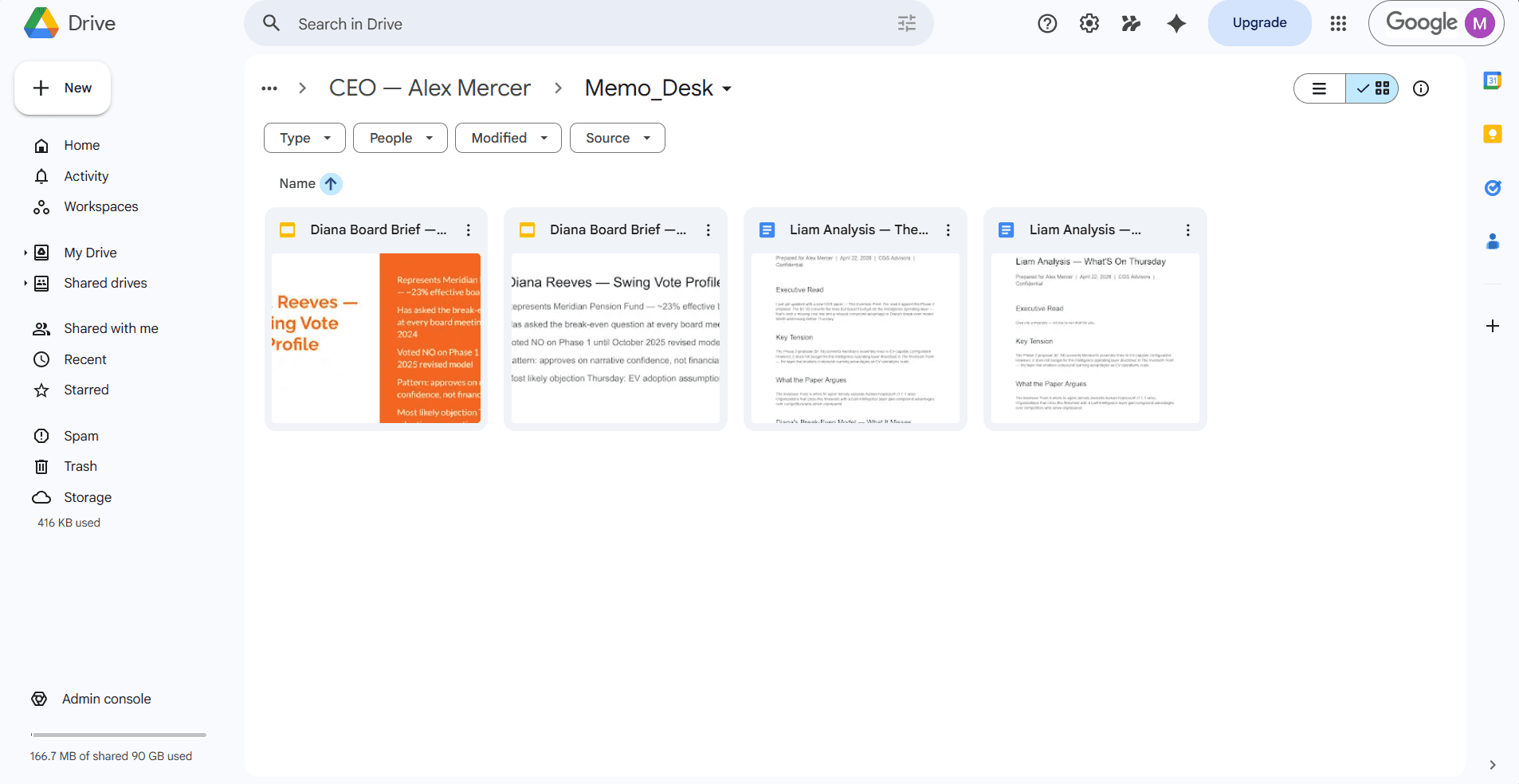
And the memory is the part the room leaned forward for. Liam learns in three places at once.
Within a seat — how a specific executive thinks.
Across a tenant — patterns between executives at one company.
Across CGS itself — every paper, every framework, every playbook, lifting every Liam at once.
But none of it trains a model. Client data never moves. What flows between layers is shape, not content. Memory, not training. The architecture is the privacy promise.
From hours to seats.
The technical pitch was Liam. The business pitch was something bigger.
Consulting has always sold hours. A partner shows up, the meter runs, the engagement ends, the relationship goes silent until the next email. That model worked when expertise was scarce. It doesn't work when AI made hours irrelevant and turned generic expertise into a commodity.
So we proposed a different model. Don't sell hours. Sell seats.
A seat is the unit. Each executive at a client — CEO, CFO, CSO — gets their own private context inside Liam. Their own Memo Desk. Their own continuous relationship with CGS's intelligence. Priced per seat, per month. Always on.
Onboarding a client is one step: CGS adds Liam's service account to the client's Google Drive, the same way they'd add a consultant. Liam wakes up knowing the business. Offboarding is one step too. Remove the access, and Liam stops reading, writing, or learning from that client. Everything he wrote stays in the client's Drive. The intelligence remains. The relationship paused, not ended.

The shift matters. Hours scale with how many partners CGS has. Seats scale with how many executives a client has. One is capped. The other compounds. And CGS keeps the relationship live between engagements instead of going dark.
The framework didn't change. The delivery did.
A Bigger Vision: First Mile.
Liam was the product we pitched. But it was always meant to sit inside a bigger vision we had for CGS.
A consulting engagement happens in three phases: before, during, after. A consultant is needed in all three. But a single firm can only put a partner in so many rooms.
So we mapped a system where a CGS product covers each phase, and the partner stays the human anchor across all of them.
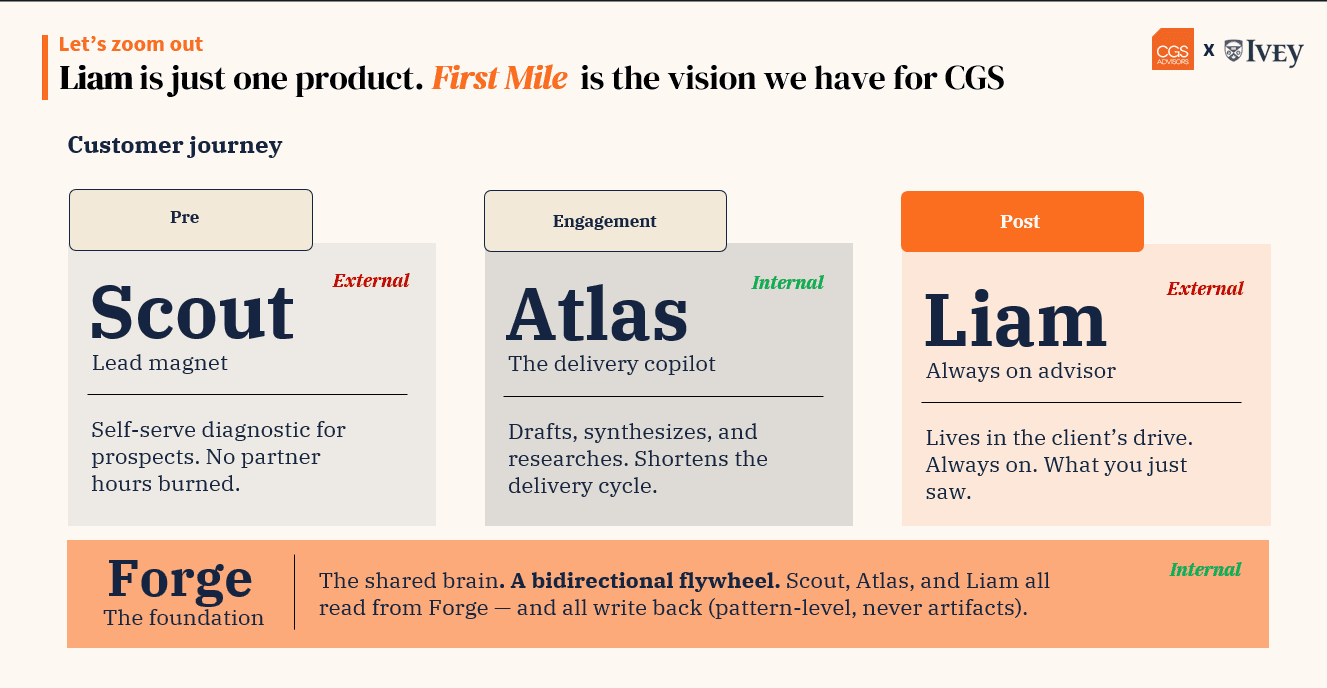
Before the engagement, Scout runs a self-serve maturity diagnostic as a lead magnet. A prospect gets a credible read in twenty minutes. Zero partner-hours burned. The engagement gets qualified before it begins.
During the engagement, Atlas is the consultant-side copilot. It synthesizes research, drafts deliverables, accelerates fixed-fee work from the inside. Margin protected.
After the engagement, Liam is the one we built. The one that stays.
And underneath all three runs Forge, the shared brain. Every CGS paper, every framework, every pattern that any product surfaces gets fed back. The more First Mile runs, the sharper First Mile gets as learning compounds.
We called this bigger vision system First Mile. The first thing a CGS client touches and the last thing they let go of.
What I learned through this experience
DiveIn, my previous agentic AI project, didn't win with the client because I built first and framed second. Liam won because I did it the other way around.
The real shift wasn't the technology. It was learning to lead the pitch with the customer journey, the pre-engagement, engagement, post-engagement arc that consulting actually runs on, instead of leading with "Hey look at this amazing thing I built for you and how complex the tech is"
For DiveIn, I'd architected fifteen agents, a coordination hierarchy, a CMO-style orchestrator. Technically impressive. Strategically blind. I never mapped where in the customer's journey those agents created value. So when we pitched, the room saw a tech demo, not a business proposal. We didn't place top three.
For Liam, the first night was reading about CGS, their work, their white papers, not coding. I wasn't reading them for product ideas but to figure out where in CGS's customer journey the gap actually was and the answer wasn't "during or after the engagement" (CGS already had that). It was between engagements. The silence after the partner leaves. That's where memory dies, where context evaporates, where clients get a "back Tuesday" auto-reply.
Once I'd named the gap, the product almost designed itself. An always-on advisor. A seat per executive. Memory that compounds. Five agents instead of fifteen.
The pitch followed the same logic. We didn't open with the architecture. We opened with Alex, a mock client and a CEO emailing his partner at 9:47 PM on a Sunday, getting an auto-reply, opening Liam instead. Walk the journey. Then show the system that closes the gap.
That's the inversion I missed the first time. A consulting firm's product isn't a deliverable. It's a way of being in the customer's journey when the partner can't be. Build for the journey, and the architecture follows. Build the architecture first, and you spend the pitch translating instead of selling.
To me the Hackathon wasn't about getting better at building agents. But it was also about getting better at finding where in someone's life a product belongs before deciding what the product is and framing the sell in a way that is relatable to the client than to flaunt my build.

